 The poetry of brothers Robert and Jonathan Jackson is the kind of sharp, cynical cityscape philosophy that you would hear from the alluring figure in the corner of the bar, constantly observing and hiding a past that might have been difficult.
Until now, their words have lain anxious on the page; but thanks to the enthusiasm of Rothko‘s Mark Beazley, a collection of the poems has been given suitable soundscape backings and with that the opportunity to escape back into the vibrant, grimy streets from whence the initial inspiration sprung.
With eight poems chosen, four from each brother, this is a concise adventure; the brothers’ ability to capture the essence of an observation in a handful of seemingly off-the-cuff lines is impressive and with Robert’s delivery urgent but humorous, the words spill around you. It feels like being given a guided tour of far from salubrious surroundings where “ham-faced accountants” litter the city streets and “corpses on elbows” line the seedy bars. The references will resonate with British folk of a certain age; I was particularly amused to hear Will Hay and Red Ken appear in the same line and the love of wordplay from both brothers is a delight.
What Mark has done to support the words is to lay a bed of found sounds which act like we are actually out and about accompanying Robert as he points and opines; “5 O’clock Barbarian” is replete with the sounds of travel, while “That Bastard Kevin” is backed with brutal noise befitting the frustration. There are rail announcements that will be familiar to London travellers on “Gordon’s Cumulu Nimbus’ which merges the indoor of “bins full of Bensons butt ends” with the pastoral outdoors of the “fried-egg sun going cold”; while “Rain Shiny Streets” shares its poignancy with the ring of bells.
“Two Gem Lettuces” comprises two lists; one a slew of the ills of the modern capitalist society offset by an inoffensive shopping list, while “The Tube” revels in dubby echoes and unspooling space. It is a surprisingly varied series of brief vignettes, with perhaps the most moving being the final piece where oscillating tones highlight the despair felt from observing the destitute; the point where Robert muses on the fallen “Tennents superman” feels acutely confessional, bleak but essential.
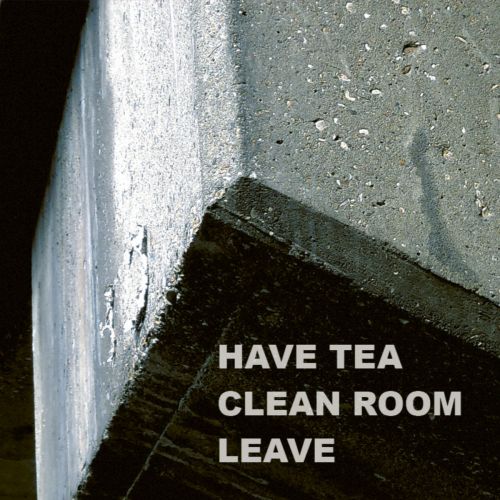
Have Tea-Clean Room-Leave is a great little body of work drawn to our attention by Mark’s keenness for others to hear it. The observations are difficult at points, but seem absolutely essential for both writers and it is doubly painful that Jonathan didn’t survive to see this release. The title is a note found amongst his things seen as a list of achievable acts and perhaps shows the struggles some people have just to go on day to day.
-Mr Olivetti-