 I’ve probably said it before on Freq and I’ll probably say it again that ‘microtonal’ is a wriggly ole’ bugger to pin down.
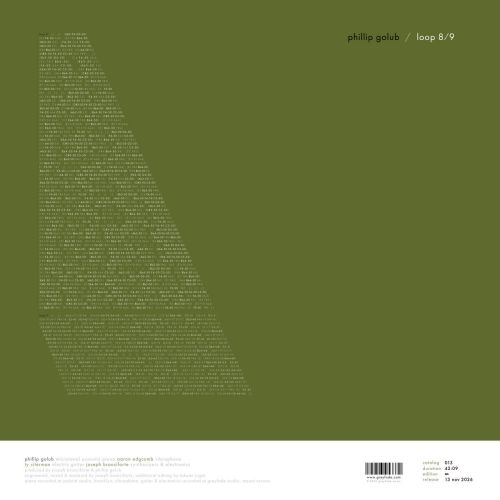
In a sense it means something about ‘music outside 12TET’ [twelve-tone equal temperament] but, it transpires, that’s most music. There’s a feeling that Angine De Poitrine have pricked a lot of ears towards non-12TET music and also a sense that there’s a whole massive shitload of people who’ve gone a lot deeper than AdP. Enter Phillip Golub stage left then.
There’s a couple of superficial similarities that I want to peel off first — Morton Feldman‘s solo piano works or the likes of Horațiu Rădulescu. Feldman because this is sparse chord cycles, irresolute and frigid; Rădulescu because his spectral works often relied on tuning systems that rendered intervals most peculiar. I suspect neither comparison are fair for Golub’s music.
It’s certainly an unhurried and nominally genteel music. Anyone who’s listened to La Monte Young‘s The Well-tuned Piano will be aware of how natural intervals first hit the ear as odd and quickly become relaxed; I’m not sure if Golub is using just intonation tuning systems like Young, but there’s that feeling that the odd tuning settles onto the ear. Track 1 (“Loop 8”) doesn’t figure too highly in the rhythmic variation; largely a meditation on a few microtonal intervals with a soupçon of digital effluvia speckling the edges. Track 2 (“Loop 9”) goes somewhat harder.
One of the acoustic effects that’s most striking is the shadowy presence of vibratoed decays, a little haunting vibraphone tailing off. I think there’s ample processing going on and plenty of sparing drama. There’s a wee effect the occasional rapid triplet of what sounds like two or three notes tuned very closely together. And that’s a virtue of the record and a point to jump off about microtonalism (if such a thing can be said to exist).
A difficulty I find with microtonal music is that there’s a lot of work to figure out intervals (checkout the Xen Wiki) and different ways of manifesting microtonal systems, but often the practitioners struggle to find the right means to show off their tuning systems. You’ll get the occasional interesting work where JS Bach is played in some weird tuning system, but also a lot of stuff that’s mere exposition of tuning systems rather than an exposition of music for a tuning system. By contrast, if you want to find tunes to play in Arabic tuning systems, they are legion — the tuning system is settled and well-developed.
I say that to point to what Golub has done excellently here — because the basic work is based on loops, and the adumbrations are subtle and small, there’s plenty of time to settle into what the tuning system is doing where the overtones are clashing. A decent exposition but, critically, also a musical exposition. Musically it’s possibly like going mad in the middle of a bar of Fryderyk Chopin.
There’s another wee soapbox there that I should probably itch — one of the interesting effects of microtonal music for me is that it’s difficult to associate it with emotion. A 12TET minor 3rd has whatever connotations we bring to it, but when that connotation is problematised by being ‘microtonal’, it’s difficult to build that association. In turn I suspect that’s where Golub’s decision to go slow and loop-y is germane — this isn’t a work like JS Bach’s Well-tempered Clavier exposing musical fluidity in multiple keys and, given the lack of associations the listener is likely to have with his tuning systems, that’s got to be more engaging.
This is a lovely record. It’s also a lovely record that sounds like it’s been in the sun too long. Recommend.
-Kev Nickells-