
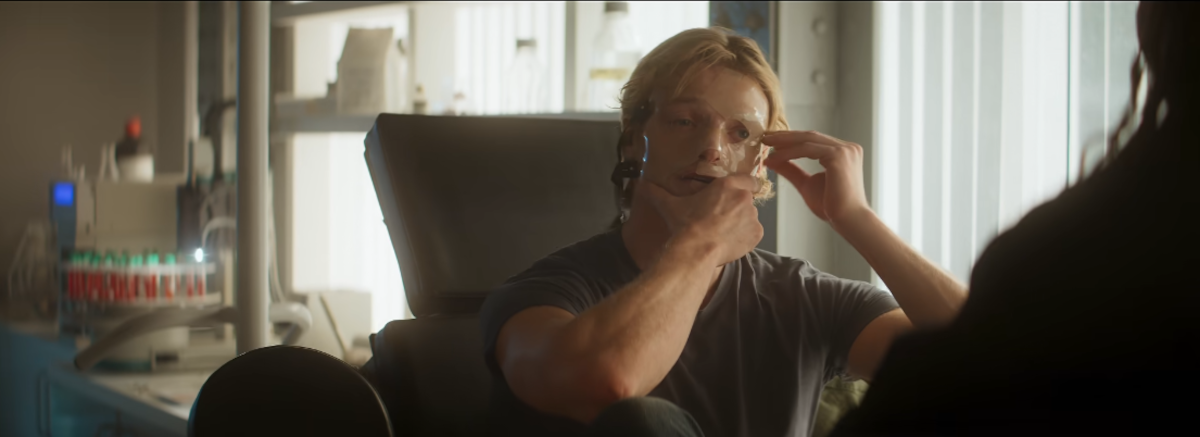
 One of the most distinctive members of Batman’s rogues’ gallery of villains gets his own origin movie in a comparatively brave and bold entry from the still box-fresh DC Universe, in which up-and-coming actor Matt Hagen seeks treatment for a recent and explicitly violent disfigurement that is so radical it gives him some unexpected and very messy superpowers.
Unsurprisingly, Clayface lends himself rather well to the body horror genre, even allowing for some contemplation on the ubiquity of cosmetic surgery in Hollywood, and the vanity that drives so many of us mad, both inside and out. Like Sam Raimi’s Darkman, Hagen uses his strange new abilities to get his own back on those who ruined his wonderful life.
The bright yellow Californian sunshine is given a sickly, claggy quality that shines outdoors and in, poisoning both the daylight and the interior gloom. Light itself seems to glide off everyone’s skin, which appears to have been vigorously massaged right up to the moment the director yells “action!”
Gotham City is designed to look like New York of the 1970s, a visual touchstone that recalls the grim landscapes of Martin Scorsese and Sidney Lumet, albeit by way of 2019’s far less prestigious and far more self-consciously serious Joker movie. The cast’s Harvey Keitel accents and a soundtrack stuffed with soul and yacht rock helps with this general evocation, even if it goes nowhere.
Elements in the set design, such as kaleidoscopically cracked mirrors and textured glass windows, are used to warp the image of the person seen through it or reflected in it, establishing a theme of transitioning from one personality to the other. For actors it’s usually just a psychological technique, but here it becomes something quite tangible.
The revolting make-up is the film’s primary weapon for taking a commendable swipe at Hollywood’s eternal fixation on physical beauty. It’s all so gleefully unsanitised, and often genuinely hard to watch, unless of course you’re the kind of viewer who loves to squirm in their cinema seat.

With the assistance of a somewhat functional script by Mike Flanagan and Hossein Amini, Tom Rhys Harries makes some effort to paint Matt as an approachable, down-to-earth kind of movie star, perhaps in the Brad Pitt mould. They all want us to root for him despite his unimaginably exalted life of nightclubs, private jets and Oscar nominations.
On the other hand, the more bitterly envious members of the audience might simply rub their hands in anticipation at the prospect of his downfall. When Matt’s chameleonic thespian abilities come in very handy in the vengeful third act, they’ll be just as happy to point at the screen and say, “I told you so!”
Still, director James Watkins has a habit of isolating his ‘hero’ from friends and sycophants, foreshadowing the loneliness of his horrendous new circumstances. Scenes in which Tom Rhys Harries reminisces about his glamorous former life allow him to plumb the depths of his pain, even through all that latex; fortunately, his assailants left those wide blue eyes alone.

Naomi Ackie brings a sassy intelligence to the Esmeralda role of the wronged scientist who gives Matt his face back, but despite a pot-stirring love triangle (completed by working-class cop stereotype Max Minghella) she’s given little to do but flirt with him, or simply recoil like a scream queen from his latest polymorphic misadventure.
The film grasps at the possibilities of its 18 rating by dropping f-bombs while a bare-naked lady strolls through the shot, not to mention wallowing in bloody scenes of torture. They seem only too keen to satisfy that certain type of comic-book fan whose mouth will froth at such superficial sops to their childish idea of a ‘grown-up’ movie.
But this latitude also extends to some enjoyably icky moments, especially one trailer-ready scene in a toilet on a turbulent aeroplane, which involves an unruly eyelid, a pair of scissors, and some impressive reserves of willpower on the part of the stricken protagonist. And it’s all shot in microscopic close-up, so get ready to clutch your armrests.

Clayface transplants a familiar SF / horror trope on to the gym-toned body of the superhero movie, and although it musters a few insights into the ugliness of human vanity, it’s chomping at the bit to unleash its malleable anti-hero so he can wreak his revenge. Those sequences are imaginative and fun to watch, especially for the ghouls among us, but the film is seldom as interesting as it might wish to be.
-Stew Mott-