
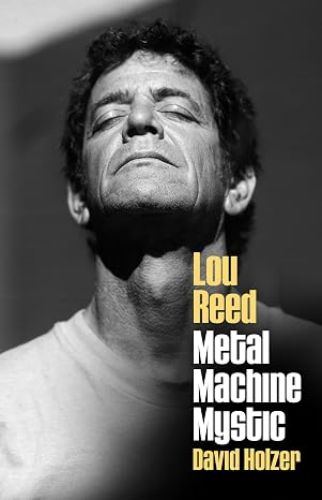
 Righty right then. Do you need another book about Lou Reed? No. Do we need this book about Lou Reed? Yes.
There’s a lot of journalistic cant gets disseminated about Reed and much of it is peurile, wasteful, pointless shite. The drugs and depravity narrative, the great rock n’ roll myths of white (or white-ish) men saying “fuck you” to the system. And it’s all largely boring.
Luckily, its subjects are typically as drab as its writers. I’m not sure how Lou Reed slipped the net, but he never deserved to be part of that canon. Perhaps worst of all — and the case is made here in part by David Holzer — Reed was quite capable of playing journalists and was quite capable of playing into the snotty ne’er-do-well.
Importantly to this book — and I’d say, any serious account of Reed’s work — his snottiness was never a vacuous phyrric gesture. I wouldn’t say that Holzer is making the case that Reed had public and private sides, but rather that he was capable of presenting different facets. But this isn’t per se a book inferring what Reed’s personality was like — rather it’s a book taking Reed’s art seriously and taking Reed seriously.
The main focus of the book is Metal Machine Music, and Holzer spends an amount of time pointing out that Reed himself would chat as much shite about the record as anyone else. But the imperative parallel current is that Reed took MMM very seriously. For all the controversy around the record, Holzer digs around and finds plenty of support for his case that Reed was deadly serious about it, and that it formed a kind of backbone to his art for the fifty years that followed. There’s also a strong conviction — and I can’t say I disagree with it — that Reed’s spirituality, taking in theosophy, tai chi and ‘new age’ ideas, is manifest in it, while also recognising that he was speedy as fuck while making it.
I’m inclined to be sympathetic towards Holzer’s vision of MMM and Reed in general. I love Reed, but by the time I got to MMM I’d already immersed myself in your Iannis Xenakises, Krzysztof Pendereckis, György Ligetis on one side and plenty of scuzzy noise on the other. It’s never captured me as an album — which isn’t to say that I don’t think it’s a banger, just that I’d found stuff that it’d done elsewhere. Many people make the case in this book that it’s a singular and untouched record and I’m not quite inclined to agree — rather that the technical means to produce an MMM weren’t available to most until quite a bit later. Not a criticism.
I do love lots of Reed. And MMM is important as a record that says he’s an artist, doing artist things. Important because while the narrative says that people returned it in their thousands, I’m sure plenty had their minds split open (cough) by it. Not only that, but it contextualises Berlin (my favourite record) as another very serious album. Witty and bitter and as bleak as infant mortality, but very serious. The Reed that emerges into the twenty-first century is one who takes his form very seriously and isn’t faffed about hounding the zeitgeist.
I’ve threatened since it came out to do a review of Lulu, which is another Reed favourite of mine (my favourite by Metallica too, but they are unmitigated shite otherwise). The basic take is that a man in his sixties singing (with somewhat depleted voice) about impotence and sexuality while emasculating one of the silliest divorced-dad-metal bands is absolutely ingenious. But the point isn’t that it’s situationism or contextual — rather that Lulu assumes its audience are grown-ups who are ready to hear lyrics about impotence and misogyny.
Holzer doesn’t make that case, but he does argue that Lulu, like MMM, isn’t some churlish gesture of antagonism. Whether it’s a failed experiment or not (I’m strongly in favour of ‘not’ failed), Reed’s art deserves the dignity of proper appraisals. (Doesn’t have to be serious and austere or old-world classical music journalism — just assuming the author’s intention is sincere).
There are some lovely touches in this — a wee segment on Rachel Humphreys, Reed’s partner who seemingly had a torrid time of it. And a torrid time with Reed. But she’s passed over by many appraisals of Reed, while this clearly puts her in the centre of his life, a real functioning person with a proper role (on tour with him) and not merely rendered as Reed’s ‘tragic’ trans lover.
There’s plenty also to contextualise MMM — whether in the Xenakis / La Monte Young realm or the likes of ‘experimental’ contempoararies like Frank Zappa. Zappa apparently did anti-speed ads because West Coast Americans were more into coke. What a cunt. What an utterly incorrigible cunt that man was. Such a cunt. You can hear it in the music. It’s just music for and by cunts.
One of the threads that Holzer pulls at is that of Alice Bailey, associated with ‘new age’ thinking and apparently Reed was a fan. The thread that Holzer isolates is that the kind of meditative practice that results in Reed’s long-term tai chi classes (he died shortly after doing some tai chi) and his Hudson River Wind Meditations (an ‘ambient’ album with meditative associations) was present in MMM; in many ways, his twenty-first century work (The Raven, the staging of Berlin) is reflective of Reed’s comfort in that arty side being validated. The Zeitkratzer ‘transciption’ of MMM validating what many had lazily dismissed as “punk before punk”.
I say ‘transcription’ there because there’s some discussion about what the Zeitkratzer rendition is — and I’d argue that it’s a version of MMM, it’s an inspired take on MMM, but it is not a transcription in the sense of reproducing the record on different instruments.
I think Metal Machine Mystic is a fucking excellent book. I worry that it’s a book for music nerds and that the public perception of Reed will continue to be that lumpen and asinine gobshite one. And if it’s not clear, there’s proper historical research here — such as Holzer furrowing about in the Lou Reed archive and finding that the parts for MMM concretely go all the way back to the mid-’60s (validated here, should you be interested). Which aligns neatly with his documented full-moon meditations. And while it is a nerd-y book there’s plenty of hilarity in here. The interviewed upstairs neighbour Karl Matusak (with no small amount of winking) talks about living around Reed.
An oddity — Holzer mentions at one point that the voices of The Breen in Star Trek Deep Space 9 are based on MMM; he also earlier mentions J Marks as the producer of a weird record of cut-up interviews and music in relation to Reed’s possible relationship with electronic music. Holzer asserts that the same J Marks became Jamake Mamake, a huckster who sold himself as a Native American expert despite being very much not Native American. In which capacity (unmentioned by this book) Jamake Mamake Highwater was an adviser to Star Trek Voyager.
So I am into this book. I’m saying that. I do think it could do with a smidge more editing. I’m not sure if that’s the pre-release version I read or not so have your pinch of salt (and that’s also why I’m burying this point way down in the review). There’s a few typos — fine, that happens, Terry and Tony Conrad are similar enough.
There’s a lot of burying good content in footnotes and I’m not sure the caprice of Reed retiring to Japan is telegraphed enough to make it not an odd detournment. There’s a really great point about the ripping solo on “Waves Of Fear” on a live album in the early ’80s, but the solo is attributed to Reed — and that, unless I’m much mistaken, is very much the handiwork of Robert Quine. But that won’t spoil your enjoyment of the book, and if you’re foolish enough to wait for the second edition you won’t know what I’m on about.
And d’you know what? Metal Machine Mystic made me go back to Metal Machine Music with fresh ears. And I’ll probably spend the next week pointing those fresh ears at some more of Lou Reed’s oeuvre. I found this, which is MMM slowed down, which is absolutely worth a go insofar as it gets a lot of detail that I’ve never gotten out of the regular MMM.
Oh, another important thing — the popular narrative is that Lulu was Reed’s last record, “another great fuck you”. And Holzer is smart enough to recognise that Reed had a bunch of late records — The Metal Machine Trio with Ulrich Krieger and Sarth Calhoun; his trio with Laurie Anderson and John Zorn; his Hudson River Wind Meditations. And they’re all Reed, the Reed who was a regular mediator, someone who took his art seriously, someone who loved making an ungodly racket and someone who valued stillness.
Anyway, yeah. A fucking excellent book. Intelligent and thoroughly researched but personable. Academic in the sense of being done well, but not academic in the sense that it’s eminently readable. Charming, well-written, passionate and emphasises that Lou Reed was better than the rock hacks would have him be. His week did, indeed, beat your year.
-Kev Nickells-


