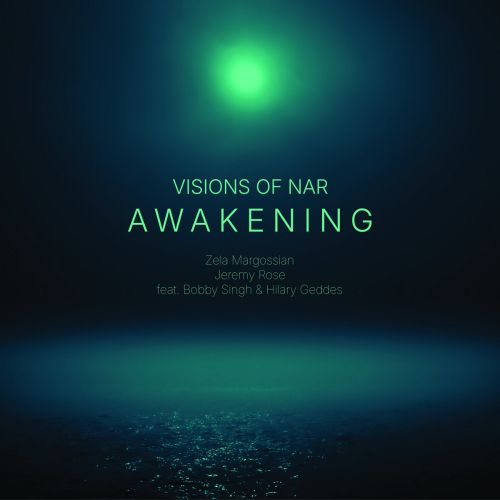
 Visions Of Nar‘s combination of piano, reeds, tabla and guitar is an intriguing one that merges different nationalities into one amorphous dreamy sound.
Although the reeds of Jeremy Rose and the piano of Zela Margossian entwine in such an effortless way, they are borne relentlessly by the tabla of Bobby Singh. It means that for a sound that could easily drift away, it is instead steadily driven, but with a subtlety that would not be the case with standard drumming. With ten tracks, half written by Zela and half by Jeremy, they open up a world that is in places diffuse yet sultry and in others unfamiliar and surprising.
The sax in opener “Cri De Coeur” is exploratory, with the classically minded piano hypnotic in its insistent refrain. The tabla adds the shifting momentum and helps create something slightly unfamiliar. The sax’s fluttering leads the storytelling line, with the piano supporting these more extravagant outbursts; but as the album progresses and the songwriter changes, so the emphasis shifts backwards and forwards between instruments.
There is an unusual time signature to the playful piano on “The Little Things” that had me thinking of Dave Brubeck, but more astral and adventurous. The instruments expound and then circle back around to a motif until the sax breaks free, its scream echoing off canyon walls and shaking us out of any calm.
They create different moods as the album proceeds and the tabla flows like a river, sometimes quiet and only just within hearing; but then rushing on, encountering a waterfall and using the gravity to drive the song. It is very easy to follow each constituent part such is the mix of the album, so the piano doesn’t encroach on the sax and the guitar offers unexpected textural detail when necessary. You do notice the longer pieces beginning to drift as if when they start, the constituent parts inhabit linear paths that gradually diverge until the tabla reins them back in; but there is a deep sense of restlessness that informs the overall sound.
There are classical piano motifs that appear as on “Let’s Play In The Fields”, which is joined by the folky sound of a soprano sax to evoke frolicking in summer meadows. The piano is more desolately romantic on “Blessings” and is joined by bass clarinet to lend a melancholy tension to the proceedings and this is the way the album moves, even taking in more abstract elements on the shadowy “Eat Chaos” that finds the tabla harbouring darker leanings. Things are more expressionistic and textural here, with a spiritual element to the sax that shows there are few directions the group won’t travel. The guitar backdrop adds to a welcome sense of displacement, not allowing the listener to make any assumptions.
Awakening is just that, an unfurling of talent and virtuosity that combines to produce a multi-layered adventure that constantly draws you back for more.
-Mr Olivetti-