 Hood were one of the most important and interesting bands working in the nineties and noughties indie music scene, taking as they did a very English pastoral aesthetic and infusing it with post-rock touches, wry experimentalism and a love of the great outdoors in all its seasonal variation. Proud of their Northern English roots, they also had an incredible work ethic, turning out six albums, a handful of cassettes and an enormous amount of 7″ singles (seemingly for any label that asked) within their lifespan, but all inspiring and without any drop in quality.
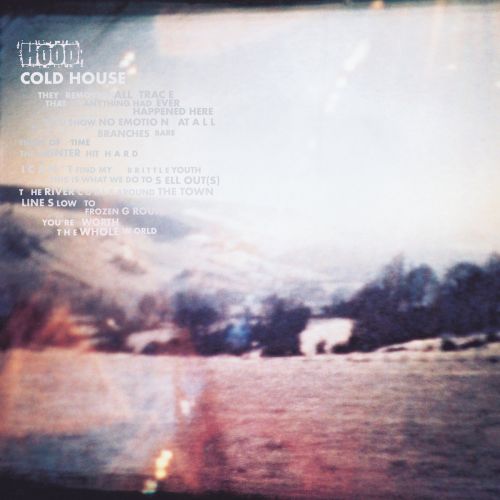
Of the six recognised studio albums, their fifth, Cold House, which is receiving a twenty-fifth anniversary reboot from Domino, is possibly the apogee of their career where, having shaken off some of the ramshackle home-recorded elements of their early work, they started to integrate samplers and electronics into their sound. The album found them embracing the kind of glitchy awkward beats that some of the more outré electronica and IDM artists of the era were plying. If the two forms sounded like odd bedfellows, Hood managed to make it sound perfectly natural, adding a further array of textures and icy surprises to an already bristling armoury.
The album itself consists of ten tracks, over half of which meander into the five- to six-minute mark, each one appearing like a fully formed expression of restless intent, but with a thread that binds throughout. As a whole, Cold House is even more varied than its eclectic predecessor The Cycle Of Days And Seasons, so the drone of the cello and the squelchy beats with mournful guitar and tired, weary vocals set out the stall on opener “They Removed All Trace That Anything Had Ever Happened Here”. Its merging of the pastoral and the glitchy is laid over an insidious hollow beat, while the variety of vocal deliveries give an edge to the proceedings. It is as if three different groups had conspired to make a six-minute album and then decided they would just continue indefinitely.
The sense of searching and the reticent vocal delivery are familiar from previous albums, but here have been augmented; so the gentle acoustic melody and the delivery of the line “I can’t stand the thought of you alone” are accompanied by chill electronic conditions. This crisp clarity engages with the warmth of a forlorn trumpet to create an evocation of a frosty morning, with any bleakness offset by a watery sun. The longer songs have plenty of time to unwind and their slower nature reveals the extra textures; the gothic bass of “Branches Bare” stands out against the shades of bleached-out colour and the line “When they cleared the house you lived so many years” sums up the sense of loss mixed with hope for the future that the sound evokes.
What sounds like a clarinet stands out on “Enemy Of Time”, while the additions and vocalisations of experimentalists Why? and Doseone lend a slightly surreal air to the already wild vagaries; there are dub elements to “The Winter Hit Hard”, with fantastically brittle percussion, while “I Can’t Find My Brittle Youth” pairs humble vocal melodies with extreme glitchiness. The album travels through a section of deconstruction and they find themselves seeing how the vocals react as the songs blur and dissolve around them. After this disruption, penultimate track “Lines Low To Frozen Ground” is perhaps the most familiar, shorn as it is of effects. The melancholic merging of trumpet, snare, voice and guitar delivers us back to more familiar territory, holding our breath as icy earth cracks underfoot.
The final track is yet another merging of a variety of touches, chord choices tugging at the heartstrings. It is wistful, yet they are clearly having fun playing around with the voices, doffing a cap to folk roots but also embracing the kind melancholy conjured up by a brass band. It is a perfect ending to what is a perfect album, a song that covers everything Hood could possibly want in majestic magpie mode.
As a work of recorded art, Cold House stands alone even after twenty-five years, but Domino have chosen to add some extra material to enhance the package. Three tracks from the CD single “You Show No Emotion At All” reveal just how important the B-side was to the band, or more realistically just how extraordinarily fertile they were.
Here you begin to realise that the album itself is as experimental as anything they set aside for the B-sides; so while “Across The Lonely Writing Side” is as accomplished as anything on the album, the waltz-like “Painting The Town Dead” heads back to their earlier, more scuffed-up and distorted lo-fi hi-jinks. “Ghosts By Japan” is the stand-out though, as though they are trying to reinvent the already sparse and deconstructed hit from the early ’80s. It is as if somebody were describing the song having never heard it, using all the musical tools 2001 had to offer.
The other additions are two early versions of album tracks that are not far off the recorded songs, but perhaps have a different vitality; the drums more deliberate and the tendency to chaos more pronounced, while three tracks from a BBC Radio Three Mixing It live event are tacked on to the end.
These show just how engaging and vital a live act they could be and what an intense sound they could produce with only four members; there is an immediacy to these versions, particularly the vocals but also a sparseness and a sense of space where the textural details are not so apparent. It had me thinking that Hood were the closest we ever had to producing the kind of hushed, spectral intimacy of The For Carnation, but with a very English depth.
Cold House was essential on release and is still now after a quarter of a century later; and in my opinion every home should have one.
-Mr Olivetti-